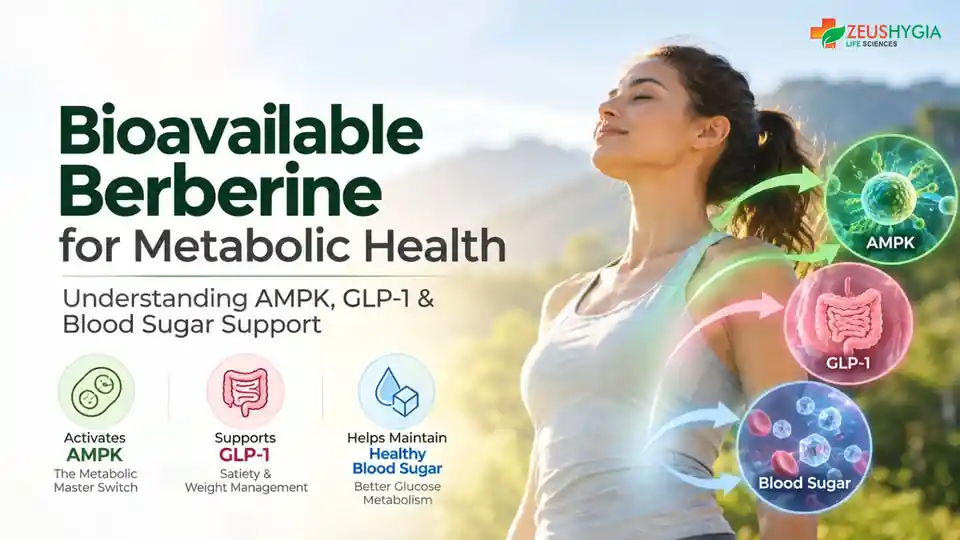
Supplement buyers are increasingly looking for plant-based ingredients that address chronic fatigue, mid-day energy crashes, and stubborn abdominal weight — three symptoms that often share one root cause: insulin resistance. Bioavailable berberine has emerged as one of the most researched botanical answers, working through two pathways that matter for metabolic health: AMPK activation and natural GLP-1 support.
What Is Insulin Resistance?
Insulin resistance occurs when your cells stop responding efficiently to insulin’s signal. Glucose stays trapped in the bloodstream, prompting the pancreas to pump out even more insulin to force cells to respond. Over time, this creates a cycle that affects energy, appetite, and body composition.
1. Chronic Fatigue
Even with plenty of glucose circulating in the blood, insulin-resistant cells cannot absorb it effectively. The result is a body that is technically “fuelled” but feels persistently low on energy.
2. Energy Crashes and Sugar Cravings
After a meal high in refined carbs or sugar, blood glucose spikes sharply. Because cells are resistant, the pancreas overcompensates with a surge of insulin (hyperinsulinemia). That excess insulin pulls sugar out of the blood too quickly, causing a sharp drop (reactive hypoglycemia) — leaving you shaky, brain-fogged, irritable, and reaching for sugar or caffeine.
3. Stubborn Abdominal Weight
Insulin resistance favours fat storage around the midsection, which is why it is notoriously difficult to lose through calorie restriction alone without first addressing insulin sensitivity.
Breaking the Cycle: Restore Insulin Sensitivity First
The primary focus should be on restoring insulin sensitivity rather than simply cutting calories:
- Nutritional adjustments: Prioritise protein, healthy fats, and fibre-rich carbohydrates to minimise blood sugar spikes.
- Cellular support: Natural compounds like berberine — and bio-optimised forms such as Metaberine™ — help activate AMPK, the cellular switch that improves glucose uptake without relying on extra insulin.
- Targeted exercise: Muscle is the body’s primary consumer of glucose. Resistance training builds muscle mass and opens non-insulin-dependent glucose pathways.
What Is Berberine?
Berberine is a naturally occurring alkaloid found in Berberis aristata extract. It has been used for centuries in traditional Ayurvedic practice, primarily for metabolic health, digestive support, and antimicrobial purposes. Today it is one of the most studied botanicals in metabolic research. The challenge is that standard berberine is poorly absorbed — which is why bioavailable berberine formats are gaining ground with formulators.
How Berberine Activates AMPK — the “Metabolic Master Switch”
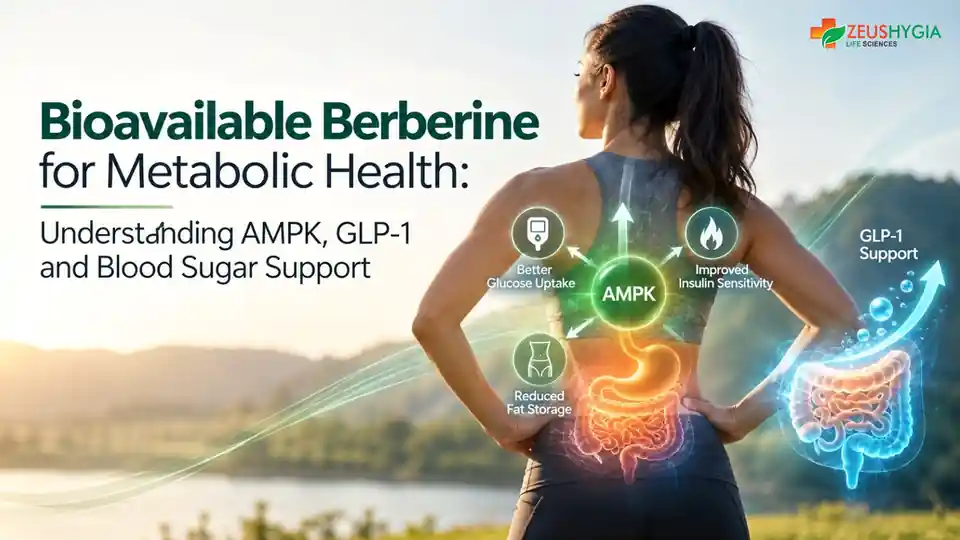
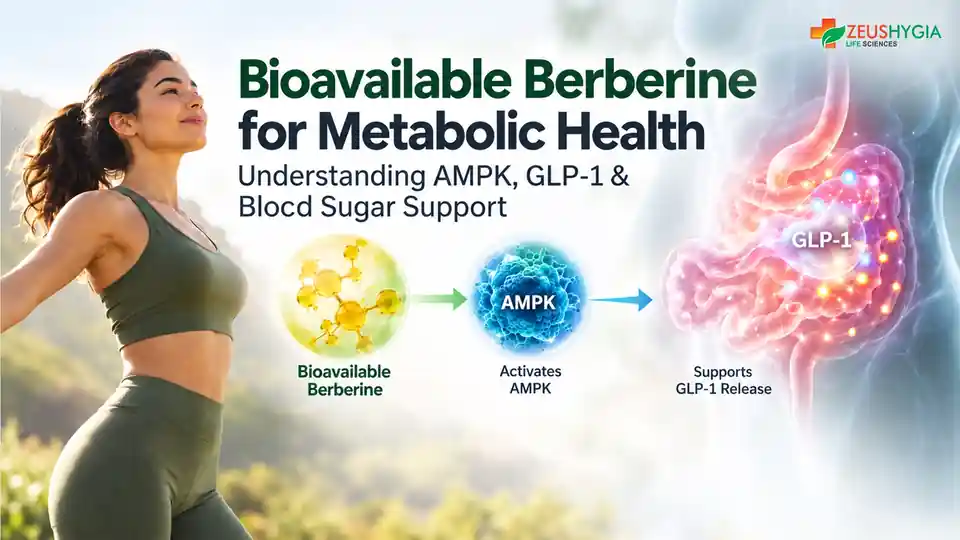
The core of berberine’s action is its effect on AMPK (AMP-activated protein kinase), often called the metabolic master switch. Research published in Diabetes showed that berberine activates AMPK, and AMPK activation is associated with:
- Better glucose uptake by cells
- Improved insulin sensitivity
- Reduced fat storage
This is the same pathway activated by exercise and caloric restriction — part of why longevity researchers became interested in berberine. Human data supports the metabolic effect too: a clinical trial in the Journal of Clinical Endocrinology & Metabolism reported improvements in glucose and lipid markers with berberine supplementation.
Berberine and GLP-1: Natural Support vs. GLP-1 Agonists
GLP-1 (glucagon-like peptide-1) is a hormone released by specialised L-cells in the gut lining, mainly in response to food. GLP-1 boosts insulin secretion, inhibits glucagon, slows gastric emptying, and reduces food intake — which is why it is central to satiety and weight management.
Pharmaceutical GLP-1 agonist injections mimic the hormone with synthetic analogues. Berberine works differently: it stimulates the body’s own release of endogenous GLP-1 while acting on complementary cellular energy pathways. Preclinical research has linked berberine to restored GLP-1 secretion in diet-induced obesity models. Berberine is not a drug substitute, but it offers a natural, food-supplement route to supporting the same hormonal system. Read more in our guide to the future of natural GLP-1 ingredients.
Metaberine™: Bioavailable Berberine With Clinical GLP-1 Data
Metaberine™ is Zeus Hygia’s bio-optimised berberine ingredient. In clinical evaluation, Metaberine™ showed a 29% increase in GLP-1 levels at 200 mg daily intake — underlining how a bioavailable berberine can support satiety and weight management at a lower dose than conventional berberine. Learn more about GLP-1 and Metaberine™ for sustainable weight management.
Why Berberine Works Broadly: Multiple Mechanisms, One Direction
Berberine does not rely on a single mechanism. It acts through several semi-independent pathways — AMPK activation, GLP-1 support, and improved glucose metabolism — that all point in the same metabolic direction. That is unusual for a plant extract and helps explain why its effects in trials tend to be broader than expected from a single-target compound. Berberine and its enriched bioavailable form, Metaberine™, can be positioned as a holistic wellness solution for metabolic health.
For Supplement Brands: Formulating With Bioavailable Berberine
Zeus Hygia supplies Metaberine™ as a B2B raw ingredient for metabolic health, blood sugar support, and weight management formulations. Brands evaluating suppliers should review our checklist on choosing the right berberine supplier, or explore our full range of branded ingredients.
Frequently Asked Questions
What is bioavailable berberine?
Bioavailable berberine is a form of berberine optimised for better absorption than standard berberine HCl, allowing effective results at lower doses. Metaberine™ is Zeus Hygia’s bioavailable berberine ingredient.
How does berberine activate AMPK?
Berberine activates AMPK, the cellular energy sensor that improves glucose uptake and insulin sensitivity — the same pathway triggered by exercise and caloric restriction.
Is berberine the same as a GLP-1 agonist?
No. GLP-1 agonist drugs mimic the hormone synthetically. Berberine supports the body’s natural release of GLP-1 from gut L-cells and works alongside other metabolic pathways.
What dose of Metaberine™ was used in the GLP-1 study?
Metaberine™ showed a 29% increase in GLP-1 at 200 mg per day in clinical evaluation.
Can supplement brands source Metaberine™ in bulk?
Yes. Zeus Hygia supplies Metaberine™ as a B2B ingredient to supplement brands and formulators worldwide.
Work With Zeus Hygia
Building a metabolic health or GLP-1 support product? Contact Zeus Hygia for Metaberine™ technical documentation, clinical data, and sample requests.
These statements have not been evaluated by the FDA. This product is not intended to diagnose, treat, cure, or prevent any disease.